 (1) S. 185, "The Jews of Suriname in a Dutch Caribbean Context": "The first Jews to permanently settle in the Caribbean arrived in the mid-seventeenth century and traced their origins to the Iberian peninsula, where many had lived for centuries as New Christians before reverting to Judaism in centers such as Amsterdam, Bayonne, and London. The place of Jews in colonial Caribbean societies is of particular interest since they were often among the first white settlers. Perhaps nowhere in the region has their impact been more pronounced than in Suriname and Curaçao, the longest-lived and historically largest Jewish communities in the early modern Caribbean".
S. 186: "On the riverside shores of the jungle, Suriname's Jews established an agrarian settlement comprising dozens of plantations and centered around Jodensavanne, or Jews' Savannah, an autonomous village where members congregated for synagogue services, attended educational institutions, and were administered justice by a secular Jewish court".
(2) S. 188: "In 1662-63, Suriname's Jewish leaders explicitly defined the two subdivisions of the Sephardic community. The Hebrew term jahid referred to a full member of the Jewish community by virtue of his or her European descent. The second-class congregante (Portuguese for 'congregant') denoted either a Eurafrican Jew or a first-class member, by virtue of his whiteness, who had been demoted to a lower social status as a penalty for marrying a Jewish female of African descent".
S. 189: "There are suggestions that in Suriname the conversion of slaves to Judaism entailed a formal ceremony carefully guided by rabbinical liturgical rites. The prayer book Sefer Berith Yitshak ('The Covenant of Isaac'), whose earliest known edition was published in 1729 in Amsterdam, includes instructions for circumcising and ritually immersing male and female slaves for conversion to Judaism"*.
―――――
* S. 191: "A similar pattern of peripheral inclusion emerged in Paramaribo's oldest Sephardic burial ground. A plot book of that cemetery lists 'rows of congregants,' where the socially inferior were interred. The decedents bear well-known Eurafrican Jewish family names, such as Judio/Judia (Jew/Jewess) and Pelegrino, as well as names of founding Sephardic families, such as d'Avilar, Cohen Nassy, and Mendes Meza, revealing an increasingly intertwined African and European Jewish lineage".
S. 197: "By January of 1820 the practice of relegating deceased congregants to specific cemetery rows ceased. The Mahamad decreed that all baptized congregants be interred throughout the cemeteries, 'without stipulation of the place of their graves.' The resolution fixed new attention on a 'book of baptisms [conversions to Judaism],' listing the names of 'congregants who are baptized and those who will be in the future.' This book suggests the existence of a significant body of fringe members of the Jewish community, hovering in a spiritual no-man's land, neither Jew nor gentile".
S. 202, "Conclusion": "Suriname's autonomous community and unprecedented New World environment allowed for the development of conversion practices only indirectly informed by halakha, and more intensely conditioned by a society distant from centers of traditional Jewish authority. The Sephardi community of Suriname can be compared to other frontier or marginal societies that developed their own definitions of Jewishness".
S.a. Arthur Bab, Rovera (Argentinien): "Surinam, eine alte jüdische Heimstätte", in: "Jüdisches Nachrichtenblatt", Ausgabe Berlin, Berlin und Wien: Jüdischer Kulturbund in Deutschland e.V., Dienstag, 21. Februar 1939, S. 2, und Freitag, 19. April 1940, Nr. 32, S. 1 [ deutsche-digitale-bibliothek/newspaper: 1939, 1940 ].
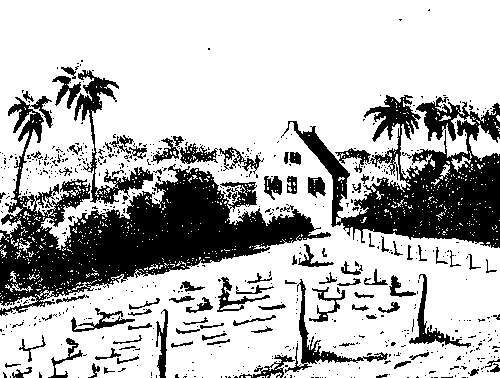
Fig. "Joden Savannah ten zuiden van Paramaribo. Gezigt op de sijnagoge en kerkhof van de zijde van het militair cordonpad gezien", between 1860 and 1862, Unknown origin, Collection Voorduin G.W.C., "op steen gebragt door J.E. van Heemskerck van Beest, Amsterdam: Frans Buffa en Zonen, [1860-1862], Plaat 6". Leiden University Library, KITLV, image 47D31 Collection page Southeast Asian & Caribbean Images (KITLV).
Register der Überlieferung der Übersetzungen bis 1950
Personenregister (Übersetzungen etc.)
Adressregister
Zurück zum Inhaltsverzeichnis
E-Mail: kriswagenseil [at] gmx [point] de