Ariel Segal: "Jews of the Amazon. Self-Exile in Earthly Paradise", Philadephia: The Jewish Publication Society 1999.
(1) "One of the most renowned New Christian families in seventeenth-century Peru"
S. 38: "One of the most renowned New Christian families in seventeenth-century Peru was the Léon Pinelo's, three brothers who were descendants of Portuguese Jews. Antonio, Diego, and Juan de Léon Pinelo gained acceptance as outstanding scholars in the Viceroyalty of Peru despite their Jewish origin and Diego's suspicious life as a crypto-Jew. No obvious evidence exists to prove that the Léon Pinelo brothers kept the observance of their forefathers' faith; however, certainly, like other New Christians, they were constantly scrutinized by Inquisition functionaries".
S. 40f.: "The Inquisition's theory of a Jewish conspiracy in the New World motivated the Catholic Church's persecution of suspected heretics. After the Dutch conquest of Bahia in Brazil in 1624, the Portuguese suspected that a connection existed between the Dutch armies and crypto-Jews of Brazil and Peru, who were conspiring to get sugar crops and mines in both colonies. In a letter addressed to the Spanish Holy Office in 1622, the inquisitors Francisco Verdugo and Andrés Juan Gaytan stated that the Peruvian city of Potosi was full of Portuguese people who belonged to the Hebrew nation and observed their Jewish rituals. How much of these reports was based on the existence of a real, vibrant Jewish life among New Christians, the descendants of Conversos, and how much was paranoia? The answer is hard to discern. A few cases prove that crypto-Jews put on trial by the Peruvian Inquisition were really practicing Jews. [...]
The son of a Portuguese Jew who had been forgiven for the crime of 'Judaizing' by Chile's Inquisition, the renowned surgeon Francisco Maldonado da Silva was imprisoned from 1627 to 1639, when he was burnt alive during the autosda-fé of La Complicidad Grande. There he proclaimed at the quemadero (stake) his last words: 'This is the doing of the Lord God of Israel, so that I may now look upon Him, face to face.' [...F]urthermore, Maldonado da Silva began to teach Judaism to inmates in neighboring cells."
(2) "[E]xactly as in Morocco"
S. 46f.: "The history of the Jews of Iquitos must be traced back to Sephardic communities in Europe and North Africa where Jews thrived in semi-tolerant Moroccan cities such as Tangier, Tetuan, Fez, and Rabat; and British Gibraltar and the city of Manchester [and - later mentioned - Alsace-Lorraine]. By the eighteenth century, commercial relations between Gibraltar and Moroccan cities linked European and North African traders, among them, Jewish merchants who eventually succeeded in settling in French and British cities and colonies from which Jews had been previously expelled".
S. 48: "Beginning in 1820, and prior to the massive late nineteenth-century migrations to Brazil, Moroccan Jews began to set foot in Brazil, seduced by the first rubber (borracha) boom. These were the first Jews to settle in the Brazilian hinterland, after having established a center for Jewish life in the port city of Bélem do Pará, where they built an Israelite cemetery and founded two synagogues: Eschel Abraham in 1824 and Shaar Hashamaim in 1826".
S. 49f.: "In 1895 most of the Amazonian Jews lived in Yurimaguas, the capital of the former province of Alto Amazonía. This city was a strategic spot for commerce because it lies between Iquitos and Pucallpa, the two major cities of the region. Many Jews who later moved to Iquitos originally settled in Yurimaguas. Alfredo Koblentz became the first mayor to rule Yurimaguas, according to public records. [...] Alfredo Koblentz and Shalom Benamú must be credited as being among the first Jews in the Peruvian Amazon [...] [Quotation Saúl Benamú Gonzales-Pavón:] There was an old man there, Natan Asarrat or Asarraf, an old Jewish man whom my father helped financially. He led the ceremonies. He was practically the rabbi because he was a very learned man".
S. 51: "[Quotation Professor Isaac Pisa, Morocco] In the lettering of the stores on the great street Prospero you can read the names Cohen, Toledano, Benmergui, Delmar, Serfaty, Benassayag, Elaluf, Pinto, etc; exactly as in Morocco. There are more than three hundred Jews in Iquitos, including Ashkenazim originally from Alsace. Of the Moroccans, one hundred are from Tangier, some fifty from Tetuan and the rest from coastal cities and from Rabat and Casablanca. In Tangier, they speak of Iquitos as if [it is] a fabulous city with streets of gold".
(3) "The 'Jewish Mestizos' as I call them, since they are the offspring of mixed marriages between Indians and Jewish white people, consider themselves Jews, celebrate Jewish holidays, and bury the members of their concregation in the Israelite cemetery estabished by their forefathers" ("Preface", S. xi)
S. 56: "After 1911, when rubber prices began to drop, only the most financially solid commercial houses survived: those of Morey, Power, Israel, and Khan. By 1911, 60 percent of the Jews in Iquitos had returned to Brazil and Europe, around 15 percent had died during their Amazonian venture, and only 25 percent stayed in the region, working in local commerce. [...] Why did the Jews of Iquitos fail to build synagogues and bring Jewish educators and religious leaders to the city, as did the Jews of Manaus and Bélem?".
S. 65: "In the midst of this religious blending, Iquitos's Jewish descendants have incorporated some of their ancestors' traditions with Amazonian Catholic rituals and beliefs that the average inhabitants share. A tiny group of 'Jewish Mestizos' still attempts to conduct a predominantly Jewish life, but they cannot escape the overwhelming influence of the Catholic Church and the jungle: 'To be Jewish in a place like this is to be a weird animal,' a third generation descendant of Jews, Ronald Reategui Levy, told me. 'It is to have a different social behavior than the rest of the people.'"
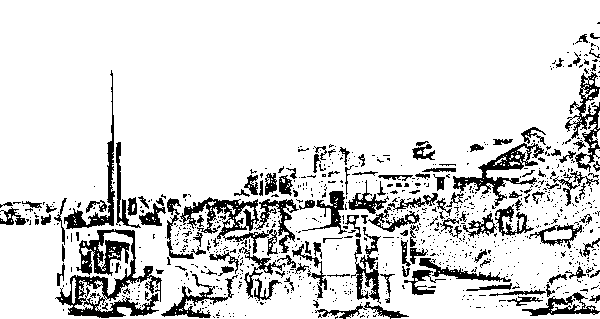
Fig. "Canhoneira peruana no Porto de Iquitos (Peru)", Imagem do Fundo Ministério da Guerra, do Arquivo Nacional, 1929-1930, BR_RJANRIO_OG_0_FOT_0001_049_B, Public Domain (modified).
Register der Überlieferung der Übersetzungen bis 1950
Personenregister (Übersetzungen etc.)
Adressregister
Zurück zum Inhaltsverzeichnis
E-Mail: kriswagenseil [at] gmx [point] de