 (1) Jay Prosser: "The Jewish Mahallah of Singapore as a Site of Transcultural Memory", in: "The Journal of Transcultural Studies", Vol. 15, No. 1-2, 2024, pp. 1-43, Creative-Commons-Lizenz CC BY-NC 4.0, uni-heidelberg.de:
"Jewish presence was first recorded in Singapore in 1830, and Jewish settlers appear in a census conducted in 1833. Most of these early immigrants, who continued arriving in Singapore up until the end of the Ottoman Empire in the 1920s, were mainly attracted by the opportunities offered by the British Empire. The persecution of Baghdadi Jews under Baghdad's Ottoman governor Dawud Pasha drove some Jewish families, most famously the Sassoons, to flee Baghdad for Bombay in the 1830s. [...]
Opportunity for trade was the main draw for Jews immigrating from the Ottoman Empire to Singapore. According to Charles Simon, former President of the Jewish Welfare Board in Singapore, the first nine Jews recorded in Singapore in 1830 were spice traders. [...] As Jonathan Goldstein's research shows, Singapore fulfilled the needs of 'port Jews': it was a city that valued trade, and a place in which Jews could attain social and civil acceptance while maintaining a collective solidarity that included non-religious bonds. The Baghdadi Jewish diaspora spread throughout Southeast Asia, in port cities such as Bombay, Calcutta, Rangoon, Penang, Surabaya, Shanghai, and Hong Kong. As Ruth Fredman Cernea writes of Baghdadi Jews in Burma, Baghdadi Jewish settlements in port cities were 'like points in a silken cobweb ... distant, but never isolated.' [Ruth Fredman Cernea: 'Almost Englishmen. Baghdadi Jews in British Burma', Lanham, MD: Rowman & Littlefield 2007, S. xv]. Singapore Jews often had familial and/or trade connections across these ports and across empires".
 (2) Digital Heritage Mapping: "Beth Shalom Synagogue at Surabaya, Indonesia", 2015:
"'The last vestige of one [of] Indonesia's oldest and largest Jewish communities is now just a pile of rubble,' the Jakarta Globe wrote in June 2013. The Beth Shalom Synagogue in Surabaya, on Java, had been destroyed a month before. The synagogue, a Dutch-style building located in the middle of Surabaya's business district, dated back to the 19th century. Except for its mezuzah and the Stars of David carved on the doors, it looked like any other residential building in the neighborhood. It had been sealed off by Islamic hardliners in 2009, after becoming a focal point for anti-Israel protests. [...] The first Jews arrived in Indonesia with the Dutch East India Company in the 1600s.6 During the 1930s and 1940s, the community was bolstered by the arrival of Jews fleeing from persecution in Europe, reaching a peak of about 2000 people".
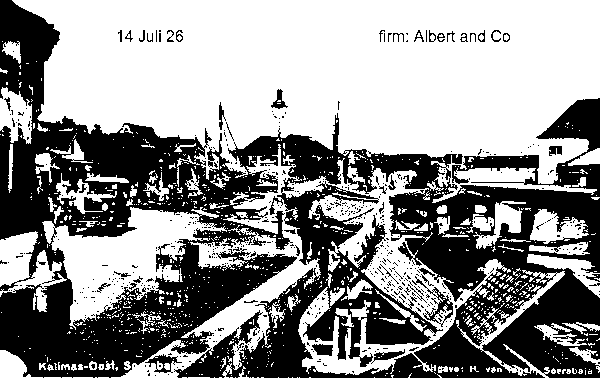
 Fig./Abb. "Prauwen langs de oever van de Kali Mas te Soerabaja", Shelfmark: KITLV 182071, circa 1930, Surabaya, Universität Leiden, unter Creative-Commons-Lizenz CC BY 4.0. Examples of Passenger Lists / Beispiele von Passagierlisten in den Zeitungen "De Indische Mercuur", 16 Maart 1927, No. 11, S. 190; "De Indische Verlofganger. Officieel wekelijksch Orgaan van de Vereeniging van Indische Verlofgangers", Vijfde Jaagang, 18. Maart 1927, No. 32, S. 383 (links).
Register der Überlieferung der Übersetzungen bis 1950
Personenregister (Übersetzungen etc.)
Adressregister
Zurück zum Inhaltsverzeichnis
E-Mail: kriswagenseil [at] gmx [point] de