 HEBREW STUDIES: A SYMPATHY FOR JUDAISM (Description from an Antiquarian)
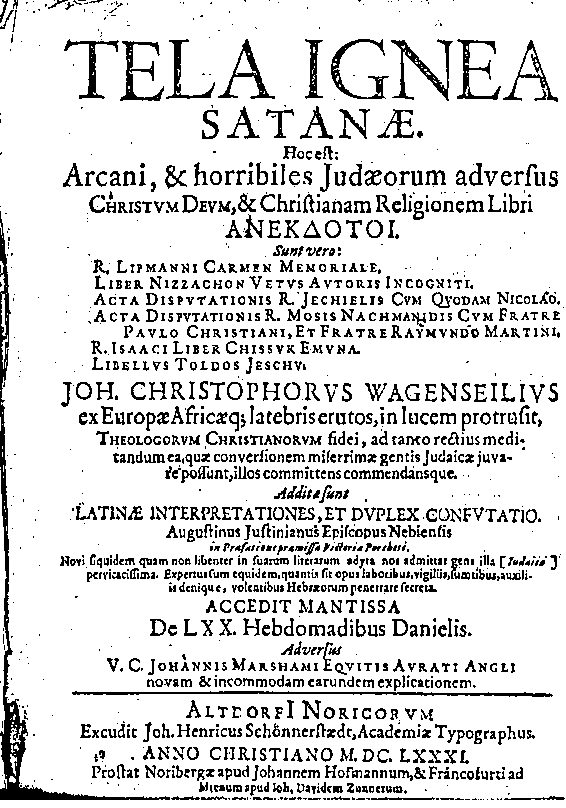
WAGENSEIL, Johann Christoph.Tela Ignea Satanae. Hoc est: arcani, et horribiles Judaeorum adversus Christum Deum, et Christianam religionem libri 'anekdotoi'.Altdorf, Joh. Henricus Schönnerstaedt, 1681. 6 parts in 2 vols., 4to., first title printed in red and black, text in Latin and Hebrew with occasional Greek, Syriac and Arabic, frontispiece-portrait of the author; a little browning here and there, but a fine copy in French 18th century red morocco, sides with three-line gilt border, gilt panelled spine with fleurons and foliate decoration in compartments, gilt edges. £5000 First edition: a magnificent copy, in a most uncharacteristic binding. The Fiery Darts of Satan, or the Secret and Terrible Books of the Jews against Christ our Lord and the Christian Religion is a more polemical title than the contents of Wagenseil's book warrant. To redress the balance we may note a comment of H.J. Schoeps in Philosemitismus im Barock (Mohr, Tübingen, 1952), "the Altdorf Professor J. C. Wagenseil who did a lot for the Jews by his courageous opposition to allegations of blood guilt and/or ritual murder ..." Perhaps the warlike title was chosen to suggest counter-armaments to the Dagger of Faith (Pugio Fidei) of Raymond Martin, which gives the Christian side of a religious disputation (see below). Wagenseil (1633-1705) was a late Renaissance polymath (the Encyclopaedia Judaica calls him "a Christian Hebraist"). He occupied various academic posts, served as tutor to the children of various princelings and travelled widely. He reports that one of the contents of this book, the Munimen Fidei, is taken from a manuscript made available to him in a trip in North Africa, and that he acquired much favour ('magnam incredibilemque statim inibam gratiam') in the town of Nundina where there was a meeting of Jews from remoter parts of the African continent, by recounting to them what was going on among the Jewish populations of Europe. Wagenseil was a formidable linguist. Page 99 of his (separately paginated, in vol. 2) reprinting and refutation of Sir John Marsham's chronological disquisition on the prophecies of Daniel (excerpted from Marsham's book Chronicus Canon printed first in London, 1672 and then in Leipzig, 1676) illustrates use of the Greek, Syriac, Arabic and Hebrew alphabets. The Fiery Darts prints for the first time the Jewish component in a number of medieval religious disputations. Thus it includes Moses Ben Nachman's side of a debate in front of King James of Aragon in Girona in 1263 A.D. with Raymond Martin and Paulus, as also Jechiel's side (he was a 13th century Parisian rabbi) of a debate held on 25/26 June 1240 in front of St. Louis, King of France, with a rabbi who had converted to Christianity. The Libellus Toldos Jeschu is a version of the Toledot Yeshu which the Encyclopaedia Judaica calls a "medieval pseudo-history of the life of Jesus. The inherent nature of birth, death and life of Jesus called forth a 'Jewish' view ... Throughout the Middle Ages many versions of the life of Jesus were written and compiled by Jews. The different writings merged into a single narrative of which nearly a dozen versions are extant ... The narrative in all its versions treats Jesus as an exceptional person who from his youth demonstrated unusual wit and wisdom, but disrespect towards his elders ... The narrative does not deny that Jesus had supernatural powers ..." Wagenseil was at the very centre of Hebrew studies in late 17th century Europe. He was in correspondence with other leading orientalists and is considered, inter alia, the father of Scandinavian Hebrew studies - he taught Gustav Peringer. Wagenseil's book includes his translations of, and in many cases commentaries on the various texts he collected. He had sympathy for Judaism and thought the conversion of Jews to Christianity, an important missionary task, could not take place unless Jews were properly treated by Christians. In a book published in 1705, Hoffnung der Erlösung Israels (A Hope for the Redemption of Israel) he wrote as follows: "therefore where the Jews are tormented and harassed one can do nothing fruitful towards their conversion". Wagenseil's name is better known for an account published in 1697 of the city of Nuremberg and the Meistersinger, which influenced Wagner, but The Fiery Darts merits serious consideration for its underlying humanity and its preservation of valuable texts. It is also, at times, written with beguiling force. Thus he reports that on reading Marsham's account of Daniel, "starting to read it, just as I'd got settled down, I fell right onto the floor, for my whole body was dumb-struck and aghast (... "totus enim obstupui exhorruique" ...) when I saw that Marsham was telling us that the end of the Seventy Hebdomades was not about Christ but about Antiochus Epiphanes ..." From the Huth library, with booklabel.
I. Erwähnungen bei Autor*innen der Aufklärungsepoche
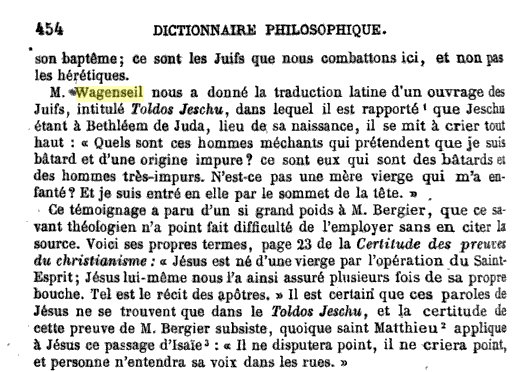
Voltaire: Le Dictionnaire philosophique, aussi nommé La Raison par alphabet, 1764
 |  |
»Doch das alles heißt ja nur eine Missetat durch das Jucken entschuldigen wollen, welches man, sie zu begehen, unwiderstehlich fühlet. Wenn es denn deine Schwachheit ist, dich verlassener Handschriften anzunehmen, so leide auch für deine Schwachheit. Genug, von dieser Handschrift hätte schlechterdings nichts müssen gedruckt werden, weil sie wenigstens eben so schlimm ist, als das Toldos Jeschu.«
Wohl angemerkt! Und also hätte auch wohl Toldos Jeschu nicht müssen gedruckt werden? Also waren die, welche es unter uns bekannt, und durch den Druck bekannt machten, keine Christen? Freilich war der, welcher es den Christen zuerst gleichsam unter die Nase rieb, nur ein getaufter Jude. Aber Porchetus? Aber Luther? Und Wagenseil, der sogar das Hebräische Original retten zu müssen glaubte! O der unbesonnene, der heimtückische Wagenseil! Sonst bekam unter tausend Juden kaum einer Toldos Jeschu zu lesen: nun können es alle lesen. Und was er auch sonst noch einmal vor dem Richterstuhl Gottes schwer wird zu verantworten haben, der böse Wagenseil! Aus seiner Ausgabe hat der abscheuliche Voltaire seine skurrilen Auszüge gemacht, die er zu machen wohl unterlassen haben würde, wenn er das Buch erst in den alten Drucken des Raimundus oder Porchetus hätte aufsuchen müssen. –
Nicht wahr, Herr Hauptpastor? Ich setze hinzu: die er zu machen auch wohl gar hätte müssen bleiben lassen, wenn Wagenseil das Lästerbuch anstatt hebräisch und lateinisch, hebräisch und deutsch hätte drucken lassen. Das wäre denn ein kleines Exempelchen, von welchem allgemeinen Nutzen es ist, wenn die Schriften wider die Religion nur lateinisch zu haben sind. Nicht wahr, Herr Hauptpastor?
Indes, Herr Hauptpastor, hat doch Wagenseil, in der weitläuftigen Vorrede zu seinen Telis igneis Satanae, sein Unternehmen so ziemlich gut verteidiget. Und wollen Sie wohl erlauben, daß ich nur eine einzige Stelle daraus hersetze, in welcher auch ich mit eingeschlossen zu sein glaube? Es ist die, welche den Hauptinhalt [243] der ganzen Vorrede in wenig Worte faßt. Neque vero, non legere tantum Haereticorum scripta, sed et opiniones illorum manifestare, librorumque ab iis compositorum, sive fragmenta aut compendia, sive integrum contextum, additis quidem plerumque confutationibus, aliquando tamen etiam sine iis, publice edere, imo et blasphemias impiorum hominum recitare, viri docti piique olim et nunc fas esse arbitrati sunt.
Celestin Demblon: "Jésus", in: "Le Petit Troyen. Journal Quotidien de la Démocratie de l'Est", 21. Année, No. 6572, Mardi, 15. janv. 1901, p. 3/4, retronews.fr
"[...] Il faut donc, sans qu'il y ait de milieu possible: ou nier comme [Charles-François] Dupuis, dans sa savante histoire de l'Origine de tous les cultes ['Origine de tous les cultes, ou Religion universelle', Paris: Henri Agasse 1795], l'existence du Christ, voir en lui une forme du mythe solaire de toutes les anciennes religions, forme qu'aurait introduite ou du moins vulgarisée a 'saint' Paul (2-65) qui fut d'abord sectateur juif d'Ormuzd et de Mithra; ou, d'après les maigres, mais seules indications vraisemblables du Talmud, peut-être du Sepher Toldos Jeschu (inséré par Wagenseil dans son Tela igneta Satanæ) et surtout des fragments qu'a conservés Origène du Discours véritable (qerdu) de Coles, indications que confirme assez la légeude évangélique eftemême quand on la dépouille du merveilleux, voir en leschou, Jeschout ou Jésus un de ces a 'prophètes' (nabis), communs en Judée éomme dans tout l'Orient, fils dit naturel d'un soldat grec ou romain, Panther ou Panthera, et d'une juive, Mirja (Miria ou Maria), qui était ou devint la femme du charpentier Jocanam ou Joseph, prêchant une simple réforme religioso-politique (et non une religion nouvelle, œuvre de 'saint' Paul) à quelques villageois de Galilée en s'aidant de faux miracles (tel la prétendue résurrection de Lazare), se faisant des adeptes, au nombre desquels l'aimante courtisane Marie de Magdala (dite Madeleine) qui le nourrit parfois, arrêté comme émeutier et blasphémateur quand il s'aventura dans Jérusalem, puis, selon des lois cruelles, ignominieusement et sommairement exécuté, comme l'avait été, entre autres Jean le bapti seur, dit 'saint' Jean-Baptiste.
Laquelle de ces deux versions est vraie? Au point de vue de la révélation, de la prétendue vérité du christianisme, cela n'impor terait guère, chacune de ces versions détruf-sant la fable naïve de la divinité du Christ, c'est-à-dire toute la religion chrétienne. Mais enfin, s'il est possible, on doit choisir. Jésus fut-il un mythe comme le pense Dupuis ou, comme l'affirme Celsecommenté par Bolingbrocke, Bayle, Voltaire, d'Holbach, etc., fut-il un enfant naturel plus ou moins glorieux? Nul doute n'est plus possible après les travaux historiques du xixe siècle. C'est Dupuis qui a raison: Jésus-Christ n'a pas existé".
Übersetzung:
"[...] Man muss also – da es keinen Mittelweg gibt – entweder die Existenz Christi leugnen, wie es [Charles-François] Dupuis in seinem gelehrten Werk The Origin of All Cults ['Origine de tous les cultes, ou Religion universelle', Paris: Henri Agasse 1795] tat, indem er ihn stattdessen als eine Erscheinungsform des Sonnenmythos betrachtete, der in allen antiken Religionen zu finden ist – eine Deutung, die von 'Sankt' Paulus (ca. 2–65), ursprünglich einem jüdischen Anhänger von Ormuzd und Mithra, eingeführt oder zumindest populär gemacht wurde; oder aber – gestützt auf die spärlichen, doch einzig plausiblen Hinweise im Talmud, etwa im Sepher Toldot Yeshu (von Wagenseil in seine Tela Ignea Satanae aufgenommen), und vor allem auf die von Origenes überlieferten Fragmente aus Celsus’ Wahrer Lehre (Logos Alethes), Hinweise, die weitgehend durch die Evangelienlegende selbst bestätigt werden, sobald man sie von den Wundererzählungen befreit – Yeshu, Jeshu oder Jesus als einen jener 'Propheten' (Nabis) betrachten, wie sie in Judäa und im gesamten Orient verbreitet waren: als den angeblichen unehelichen Sohn eines griechischen oder römischen Soldaten namens Panther oder Panthera und einer Jüdin namens Mirja (Miria oder Maria) – die die Ehefrau des Zimmermanns Jocanam oder Joseph war oder wurde –, der einigen galiläischen Dorfbewohnern mithilfe vorgetäuschter Wunder (wie der angeblichen Auferweckung des Lazarus) eine einfache religiös-politische Reform predigte (und nicht etwa eine neue Religion, was das Werk des 'Heiligen' Paulus war); der Anhänger gewann – darunter die liebevolle Kurtisane Maria von Magdala (bekannt als Magdalena), die ihn bisweilen mit Nahrung versorgte –, als Unruhestifter und Gotteslästerer verhaftet wurde, als er sich nach Jerusalem begab, und schließlich gemäß grausamen Gesetzen auf schmachvolle Weise und ohne ordentliches Verfahren hingerichtet wurde, ebenso wie unter anderem Johannes der Täufer – bekannt als „Sankt“ Johannes der Täufer.
Welche dieser beiden Versionen entspricht der Wahrheit? Vom Standpunkt der Offenbarung – der behaupteten Wahrheit des Christentums – aus betrachtet, spielte dies kaum eine Rolle; jede der beiden Versionen zerstört die naive Fabel von der Göttlichkeit Christi und damit die gesamte christliche Religion. Dennoch muss, wenn möglich, eine Entscheidung getroffen werden. War Jesus ein Mythos, wie Dupuis glaubt, oder war er – wie Celsus behauptete (eine Ansicht, die von Bolingbroke, Bayle, Voltaire, d’Holbach und anderen aufgegriffen wurde) – ein uneheliches Kind von gewissem Ruf? Nach der historischen Forschung des 19. Jahrhunderts besteht kein Zweifel mehr. Dupuis hat recht: Jesus Christus hat nicht existiert".
II. Weitere Rezeption
Alfred Edersheim: The life and times of Jesus the Messiah, APPENDIX XVIII. HAGGADAH ABOUT SIMEON KEPHA (LEGEND OF SIMON PETER.) (New York: Herrick 1886)
"THIS Haggadah exists in four different Recensions (comp. Jellinek, Beth ha-Midrash, Pt. V. and Pt. VI., pp. ix. x). The first of these, reproduce by Jellinek (u. s. Pt. V. p. xxvi. &c., and pp. 60-62) was first published by Wagenseil in his collection of Antichristian writings, the Tela Ignea Satanæ, at the close that blasphemous production, the Sepher Toledoth Jeshu (pp. 19-24). The second Recension is that by Huldrich (Leyden 1705); the thrid has been printed, as is inferred, at Breslau in 1824; while the fourth exists only in MS. Dr. Jellinek has substantially reproduced (without the closing sentences) the text of Wagenseil’s (u. s. Pt. V.), and also Recensions III. and IV. (u. s. Pt. VI.). He regards Recension IV. as the oldest; but we infer from its plea against the abduction of Jewish children by Christians and against forced baptisms, as well as from the use of certain expressions, that Recension IV. is younger than the text of Waggenseil, which seems to present the legend in its most primitive form. Even this, however, appears a mixture of several legends; or perhaps the original may afterwards have been interpolated. It were impossible to fix even approximately the age of this Christianity in Rome, and that of the Papacy, though it seems to contain older elements. It may be regarded as embodying certain ancient legends among the Jews about St. Peter, but adapted to later times, and cast in an apologetic form. A brief criticism of the document will best follow an abstract of the text, according to the first or earlier Recension. "
Vgl. The Temple - Its Ministry and Services as they were at the time of Christ, Vorwort:
"Perhaps I ought not here to omit such names as Relandus, Buxtorf, Otho, Schottgen, Meuschen, Goodwin, Hottinger, Wagenseil, and Lundius; and, among modern writers, Bahr, Keil, Kurtz, de Wette, Saalschutz, Zunz, Jost, Geiger, Herzfeld, and Fratz, of whose works I have, I may say, constantly availed myself. Many others have been consulted, some of which are quoted in the foot-notes, while others are not expressly referred to, as not adding anything material to our knowledge."
Blavatsky, H.P. : Isis unveiled - A Master-Key to the Mysteries of Ancient and Modern Science and Theology; Vol. II: Theology, Chapter 3: DIVISIONS AMONGST THE EARLY CHRISTIANS. 127 WHO AND WHAT WAS PETER? (New York: Theosophical Society 1877)
"In the Sepher Toldos Jeshu,( * ) a Hebrew manuscript of great antiquity, the version about Peter is different. Simon Peter, it says, was one of their own brethren, though he had somewhat departed from the laws, and the Jewish hatred and persecution of the apostle seems to have existed but in the fecund imagination of the fathers. The author speaks of him with great respect and fairness, calling him "a faithful servant of the living God," who passed his life in austerity and meditation, "living in Babylon at the summit of a tower," composing hymns, and preaching charity. He adds that Peter always recommended to the Christians not to molest the Jews, but as soon as he was dead, behold another preacher went to Rome and pretended that Simon Peter had altered the teachings of his master. He invented a burning hell and threatened every one with it; promised miracles, but worked none.
( * ): It appears that the Jews attribute a very high antiquity to "Sepher Toldos Jeshu." It was mentioned for the first time by Martin, about the beginning of the thirteenth century, for the Talmudists took great care to conceal it from the Christians. Levi says that Porchetus Salvaticus published some portions of it, which were used by Luther (see vol. viii., Jena Ed.). The Hebrew text, which was missing, was at last found by Munster and Buxtorf, and published in 1681, by Christopher Wagenseilius, in Nuremberg, and in Frankfort, in a collection entitled "Tela Ignea Satanae," or The Burning Darts of Satan (See Levi's "Science des Esprits")."
Word Wisdom in the Esoteric Tradition - 1980 by G. de Purucker, Theosophy glossar article "Christianity"
Wagenseil's edition commences as follows: "In the year of the world 4761 [gemeint ist wahrsch. 3761 für das Jahr Null im Gregorianischen Kalender] under King Jannaeus, a misfortune befell Israel. A profligate named Joseph Pandirah then arose. He was handsome, strong, well-made, but spent his time in robbery and hurt to others. He lived in Bethlehem, in Judaea. A widow lived near him who had a daughter, named Miriam [or Mary]. This Miriam dressed women's hair, and is spoken of in the Talmud." It then goes on to say that she became the mother of Yeshu [of Jesus] by Pandirah. Yeshu after a number of years goes into the temple, in search of the Incommunicable Name, cuts open his flesh and places therein the Unutterable Name which he has written on a piece of parchment. He works miracles through his possession of knowledge of the Incommunicable Name. Throughout the Toledoth he is called "The Fatherless", doubtless an allusion to his birth. Now there was one Judas, an Elder of Israel; he goes also into the Temple, in search of the Wonderful Name, so that he may overthrow the Fatherless, and he gets it and he works counter miracles against Yeshua or Jesus, to overthrow him. He does overthrow Yeshua or Jesus, who is finally seized and incarcerated. He escapes through the connivance of his disciples, of whom he had gained a following, washes himself in the Jordan, upon which his magic power returns to him. He then works more miracles; he causes milestones to float on the water, upon one of which he places himself and teaches; he feeds multitudes with fishes, and works many other wonderful miracles. Judas again lays a trap for him and catches him in sleep, and cuts out of his flesh the parchment upon which the Wonderful Name had been written. This of course deprives the Fatherless of his magical power, and he finally comes to so bad a pass that he has to wear a crown of thorns. He thirsts and is given vinegar to drink, and utters the exclamation "My God, My God, why hast thou forsaken me?" He is sentenced finally to be stoned and hanged on a tree. It was the eve of the Passover. He is taken out of the city and stoned until dead. Judas hides his body under a running stream by first diverting the waters and then allowing them to return into their channel. But his disciples take immediate advantage of this move of Judah, the Jewish Elder, by saying exactly as Yeshu had said, "He is now risen to Heaven, because his body cannot be found." Great excitement prevails, and to still it Judas draws the body from the bed of the brook, attached to a horse's tail, through the streets. Finally Simon Peter, one of Jesus' disciples in his turn gets into the Temple and gets the Wonderful Name, and gives himself out as speaking for Yeshu; he gets a following and finally dies highly respected in a tower built for him in the city, six years later. The Toledoth Yeshu ends here.
ANTISEMITISM: ITS HISTORY AND CAUSES, 1894 By Bernard Lazare. Chapter Seven: ANTI-JUDAIC LITERATURE AND THE PREJUDICES
"This Toldot Jesho was published by Raymund Martin, Luther translated it into German; Wagenseil and the Dutchman Huldrich also published it. It contained the story of Pantherus the soldier and the legends representing Jesus as a magician. [...] These men studied Jewish literature and manners in a more serious way. Thus Wagenseil denied ritual murder;..."
Nesta Webster: Secret Societies and Subversive Movements, Boswell Publishing Co., Ltd., London, 1924
P A R T I: T H E P A S T, CHAPTER I THE ANCIENT SECRET TRADITION:
Thus the Jewish Encyclop dia admits that Jewish legends concerning Jesus are found in the Talmud and Midrash and " the life of Jesus (Toledot Yeshu) that originated in the Middle Ages. It is the tendency of all these sources to belittle the person of Jesus by ascribing to Him illegitimate birth, magic, and a shameful death."(72)
The last work mentioned, the Toledot Yeshu, or the Sepher Toldos Jeschu, described here as originating in the Middle Ages, probably belongs in reality to a much earlier period. Eliphas Lévi asserts that " the Sepher Toldos, to which the Jews attribute a great antiquity and which they hid from the Christians with such precautions that this book was for a long while unfindable, is quoted for the first time by Raymond Martin of the Order of the Preaching Brothers towards the end of the thirteenth century. . . . This book was evidently written by a Rabbi initiated into the mysteries of the Cabala."(73) Whether then the Toledot Yeshu had existed for many centuries before it was first brought to light or whether it was a collection of Jewish traditions woven into a coherent narrative by a thirteenth-century Rabbi, the ideas it contains can be traced back at least as far as the second century of the Christian era. Origen, who in the middle of the third century wrote his reply to the attack of Celsus on Christianity, refers to a scandalous story closely resembling the Toledot Yeshu, which Celsus, who lived towards the end of the second century, had quoted on the authority of a Jew.(74) It is evident, therefore, that the legend it contains had long been current in Jewish circles, but the book itself did not come into the hands of Christians until it was translated into Latin by Raymond Martin. Later on Luther summarized it in German under the name of Schem Hamphorasch ; Wagenseil in 1681 and Huldrich in 1705 published Latin translations.(75) It is also to, be found in French in Gustave Brunet's Evangiles Apocryphes.
However repugnant it is to transcribe any portion of this blasphemous work, its main outline must be given here in order to trace the subsequent course of the anti-Christian secret tradition in which, as we shall see, it has been perpetuated up to our own day. Briefly, then, the Toledot Yeshu relates with the most indecent details that Miriam, a hairdresser of Bethlehem,(76) affianced to a young man named Jochanan, was seduced by a libertine, Joseph Panther or Pandira, and gave birth to a son whom she named Jehosuah or Jeschu. According to the Talmudic authors of the Sota and the Sanhedrim, Jeschu was taken during his boyhood to Egypt, where he was initiated into the secret doctrines of the priests, and on his return to Palestine gave himself up to the practice of magic.(77) The Toledot Yeshu, however, goes on to say that on reaching manhood Jeschu learnt the secret of illegitimacy, on account of which he was driven out of the Synagogue and took refuge for a time in Galilee. Now, there vas in the Temple a stone on which was engraved the Tetragrammaton or Schem Hamphorasch, that is to say, the Ineffable Name of God ; this stone had been found by King David when the foundations of the Temple were being prepared and was deposited by him in the Holy of Holies. Jeschu, knowing this, came from Galilee and, penetrating into the Holy of Holies, read the Ineffable Name, which he transcribed on to a piece of parchment and concealed in an incision under his skin. By this means he was able to work miracles and to persuade the people that he was the son of God foretold by Isaiah. With the aid of Judas, the Sages of the Synagogue succeeded in capturing Jeschu, who was then led before the Great and Little Sanhedrim, by which he was condemned to be stoned to death and finally hanged.
Such is the story of Christ according to the Jewish Cabalists, which should be compared not only with the Christian tradition but with that of the Moslems. It is perhaps not sufficiently known that the Koran, whilst denying the divinity of Christ and also the fact of His crucifixion,(78) nevertheless indignantly denounces the infamous legends concerning Him perpetuated by the Jews, and confirms in beautiful language the story of the Annunciation and the doctrine of the Miraculous Conception.(79) " Remember when the angels said, ' O Mary ! verily hath God chosen thee and purified thee, and chosen thee above the women of the worlds.'. . . Remember when the angels said : ' O Mary ! verily God announceth to thee the Word from Him : His name shall be Messiah, Jesus the son of Mary, illustrious in this world, and in the next, and one of those who have near access to God.' "
72. Jewish Encyclopædia, article on " Jesus."
73. Eliphas Lévi, La Science des Esprits, p. 40 [Paris: G. Baillière 1865, archive.org ].
74. Origen, Contra Celsum.
75. S. Baring-Gould, The Counter-Gospels, p. 69 (1874).
76. Cf. Baring-Gould, op. cit., quoting Talmud, treatise Sabbath, folio 104.
77. Ibid., p. 55, quoting Talmud, treatise Sanhedrim, folio 107, and Sota, folio 47 ; Eliphas Lévi, La Science des Esprits, pp. 32, 33.
78. According to the Koran, it was the Jews who said, " ' Verily we have slain the Messiah, Jesus the son of Mary, an apostle of God.' Yet they slew him not, and they crucified him not, but they had only his likeness. . . . No sure knowledge had they about him, but followed an opinion, and they did not really slay him, but God took him up to Himself."—Sura iv. 150. See also Sura iii. 40. The Rev. J. M. Rodwell, in his translation of the Koran observes in a footnote to the latter passage : " Muhammad probably believed that God took the dead body of Jesus to Heaven—for three hours, according to some,—while the Jews crucified a man who resembled him."
79. Sura iii. 30, 40.
III. Inhalt / Content
"R. Lipmanni Carmen Memoriale"
Ursula Ragacs: "Nizzahon", in: "Religion Past and Present Online. Encyclopedia of Theology and Religion", "the updated English translation of the 4th edition of the definitive encyclopedia of religion worldwide: the peerless 'Religion in Geschichte und Gegenwart' (RGG) [Tübingen: Mohr Siebeck, 1998-2007]", Leiden: Brill 2011: "The 'Sikkaron Sefer Nizzahon' (Carmen memoriale libri Nizzachon a R. Lipmanno compositi) in Wagenseil represents an abridged version of Lipman's text [Sefer ha-Nizzahon]".
Sefer Nizzahon Yashan
"Sefer Nizzahon (Yashan) (Hebrew: ספר ניצחון, romanized: sēfer niṣṣāḥon, lit. 'Book of Victory', 'The (Old) Book of Victory') is an anonymous Jewish apologetic text that originated in 13th-century Germany. The word 'old' (yashan) has become attached to the title to distinguish the work from the Sefer Nizzahon of Yom-Tov Lipmann-Muhlhausen of Prague, written in the 15th century [Allison Coudert and Jeffrey S. Shoulson: 'Hebraica veritas? Christian Hebraists and the Study of Judaism in Early Modern Europe', Philadelphia: University of Pennsylvania Press 2004, p. 177: 'An earlier book named Sefer ha-Nizzahon* was written in Germany in the late thirteenth century. The Christian Hebraist Wagenseil called it Nizzahon Vetus in order to make a distinction between it and Lipmann's book']. A modern edition was published by Mordechai Breuer in 1978, and [...] by David Berger [...]. The work was known and responded to by Protestant Hebraists and polemicists, including Johann Reuchlin, Sebastian Münster, Wolfgang Capito, Immanuel Tremellius, John Calvin, and Martin Luther".* Gedruckt von Theodoricus Hackspan: 'Liber Nizzachon R. Lipmanni editus. Acc. Tractatus de usu librorum Rabbinicorum', Nürnberg: Wolfgang Endter 1644, [ books.google.com ], nach Diebstahl des Manuskripts.
(WP unter Bezugnahme auf Stephen Burnett: "Calvin's Jewish Interlocutor. Christian Hebraism and Anti-Jewish Polemics during the Reformation", in: "Bibliothèque d'Humanisme et Renaissance", Vol. 55, No. 1, 1993; Ora Limor und Guy G. Stroumsa: "Contra Iudaeos. Ancient and Medieval Polemics Between Christians and Jews", Tübingen: Mohr Siebeck 1996, S. 196: "When one thinks of a typical Ashkenazic polemic, one generally looks to a book such as Sefer Nizzahon Yashan"; Hanne Trautner-Kromann "Shield and Sword. Jewish Polemics Against Christianity and the Christians in France and Spain from 1100-1500", Tübingen: Mohr Siebeck 1993, S. 103).
Mordechai Breuer: "Sefer Nizzahon Yashan (Nizzahon Vetus). A Book of Jewish-Christian Polemic, a Critical Edition", Ramat-Gan, Israel: Bar-Ilan University Press, 1978.
David Berger: "The Jewish-Christian Debate in the High Middle Ages: A Critical Edition of the Nizzahon Vetus. English edition", Philadelphia, Jewish Publication Society, 1979.
Yechiel ben Joseph von Paris (Disputation in Paris 1240)
"Yechiel ben Joseph of Paris or Jehiel of Paris, called Sire Vives in French (Judeo-French: שיר ויויש) and Vivus Meldensis ('Vives of Meaux') in Latin, was a major Talmudic scholar and Tosafist from northern France, father-in-law of Isaac ben Joseph of Corbeil. He was a disciple of Rabbi Judah Messer Leon, and succeeded him in 1225 as head of the Yeshiva of Paris, which then boasted some 300 students; his best known student was Meir of Rothenburg. He is the author of many Tosafot [...] Yechiel of Paris is best known as the main defender of Judaism in the 1240 Disputation of Paris held at the court of Louis IX, where he argued against the convert Nicholas Donin. This was the first formal Christian-Jewish disputation held in medieval Christendom. In defence of accusations of slanderous quotes in the Talmud against the founder of Christianity, Yechiel argued that the references to Yeshu in fact refer to different individuals. Yechiel delineates them as Jesus himself another 'Yeshu haNotzri', also from Nazareth (Sanhedrin 107b), and a third 'Yeshu' of the boiling excrement in Gittin 47a".(WP unter Bezugnahme auf Solomon Schechter und Isaac Broydé: "Jehiel ben Joseph of Paris", in: "The Jewish Encyclopedia", hrsg. von Isidore Singer u.a., New York: Funk & Wagnalls 1902-1906, David Berger: "Onb the Use of History in Medieval Jewish Polemic against Christianity. The Quest for the Historical Jesus", in: "Jewish History and Jewish Memory. Essays in Honor of Yosef Hayim Yerushalmi", ed. Elisheva Carlebach, John M. Efron, London / Hannover: Brandeis University Press 1998, S. 33: "Now, if his argument that the Jesus of the boiling excrement is not the Talmud's Jesus of Nazareth still stands, then R. Yehiel has not two Jesuses but three, two of whom came from Nazareth, and this is in fact strongly implied in the Christian response recorded in the Oxford manuscript of the Hebrew text and is explicitly stated in the Moscow manuscript").
Vikuaḥ Rabenu Yeḥiel mi Paris ויכוח רבינו יחיאל מפריס [Debate of Rabbi Yechiel of Paris] (in Hebrew). Toruń: C. Dombrowski 1873 [ hebrewbooks.org ].
Moses Nachmanides: Sefer Ṿikuaḥ ha-Ramban (Disputatio in Barcelona 1263)
"The Disputation of Barcelona (July 20-24, 1263) was a formal ordered medieval disputation between representatives of Christianity and Judaism regarding whether Jesus was the Jewish Messiah. It was held at the royal palace of King James I of Aragon in the presence of the King, his court, and many prominent ecclesiastical dignitaries and knights between Dominican Friar Pablo Christiani, a convert from Judaism to Christianity, and Nachmanides, a leading medieval Jewish scholar, philosopher, physician, kabbalist, and biblical commentator. During the Middle Ages, there were numerous ordered disputations between Christians and Jews. They were connected with burnings of the Talmud, burnings of Jews at the stake, and anti-Jewish pogroms. In Barcelona, Jews and Christians were given absolute freedom to deliver their arguments however they wanted—a freedom not then otherwise available to Jews anywhere else".(WP unter Bezugnahme auf Richard Gottheil u. Kaufmann Kohler: "Disputations", Jewish Encyclopedia, 1906; Haim Hillel Ben-Sasson: "Disputations and Polemics", Jewish Virtual Library, The Gale Group).
"Sefer Ṿikuaḥ ha-Ramban: be-ʿinyan ha-emunah lifne melekh ṿe-śarim : u-veʾur Ramban ʿal Hineh yaśkil ʿavdi = Nachmanidis Disputatio : publica pro fide Judaica (a. 1263) e Codd. MSS. recognita, addita ejusdem expositione in Jesaiam LIII", Berolini: Asher 1860, [ digitale-sammlungen.de ].
Nahmanides: "The Disputation at Barcelona", transl. von Charles Ben Chavel, New York: Shilo Publishing House 1983.
Nahmanides: "La dispute de Barcelone, suivi du commentaire sur Esaie 52-53", transl. von Luc Ferrier und Eric Smilévitch, Paris: Vernier 1984.
Nahmanides: "Disputa de Barcelona de 1263 entre mestre Mossé de Girona i fra Pau Cristià", transl. von Pau Cristià, Jaume Riera i Sans, Eduard Feliu i Mabres, Barcelona: Columna 1985.
Nahmanides: "La Disputa di Barcellona", Roma: Edizione Lamed 1999.
Reprint des Hizzūq emūnā in Amsterdam 1705 (ohne Übersetzung und Widerlegung)
Wolfgang Voigt: "Verzeichnis der orientalischen Handschriften in Deutschland", Band VI, 1a: "Hebräische Handschriften Teil 1a", beschrieben von Ernst Roth und Leo Prijs, Wiesbaden: Franz Steiner Verlag 1982, S. 117f., Nr. 84: "Ms. hebr. oct. 80. 259 fol. in Pergamenteinband [hebr. Handschrift der StUB Frankfurt am Main...]. Vermerk auf der Innenseite des vorderen Buchdeckels (auf eingeklebten Zettel): 'Sr. Wohlgeboren Herrn Dr. Carmoly Sandweg Nro. 14 in Frankfurt am Main.' Ibid. Besitzvermerk: 'Bibliotheca Merzbacheriana Monacensis'. [...] חִזּוּק אֱמוּנָה. Hizzūq emūnā. Glaubensstärkung. Apologetisches Werk. Verfaßt von Jiṣḥāq ben Abrāhām Troki aus Troki (Litauen). [...] Der Verfasser des Werkes (vgl. EJ, Bd. XV, S. 1403f., [...]) [...] war ein der Sekte der Karäer angehörender Gelehrter, geb. ca. 1533 in Troki (Litauen), gest. ca. 1594. Das Werk ist eine Verteidigung des Judentums gegen Angriffe der Christen. 'It was circulated in manuscripts and each copyist felt free to modify the text according to his own view, so that at present, pending the discovery of more authentic manuscripts, it would probably be impossible to restore Isaac's original text in its entirety (EJ, a. a. O.). [...]Erster Druck erst 1681 durch J. Chr. Wagenseil, mit lateinischer Übersetzung und Widerlegung in seinem Werk Tela Ignea Satanae, Altdorf 1681. Aus Wagenseils Ed. ist der hebr. Text allein wiedergedruckt Amsterdam 1705. Hebr. Ed. mit deutscher Übersetzung 'Befestigung im Glauben' ... von David Deutsch, Sohrau in Oberschlesien 1865. Englische Übersetzung durch Moses Mocatta, London 1851. Hebr. Ed. auch Calcutta 1846, New York 1932".
Moses Mocatta: "Hizuk Emunah. Or, Faith Strengthened. Von Isaac ben Abraham Troki", London: J. Wertheimer and Company 1851, [ books.google.com ].
David Deutsch: "Befestigung im Glauben von Rabbi Jizschak, Sohn Abrahams s. A.", Sohrau, O.-Schl., Selbstverlag des Herausgebers, Breslau: Comissionsverlag von H. Skutsch 1873, [ books.google.com ].
"Mocatta. English family of Marrano origin. Moses Mocatta (d. 1693), who came from Amsterdam, appears in a Bevis Marks (London) synagogue list in 1671. He was a diamond broker and merchant. His granddaughter Rebecca married as her second husband Moses Lumbrozo de Mattos. Their son Abraham (d. 1751), (who added the name Mocatta and later dropped Lumbrozo de Mattos) joined with Asher Goldsmid to found Mocatta and Goldsmid, later bullion brokers to the Bank of England, engaging in enormous transactions. Abraham Mocatta had 11 children (including Rachel, mother of Sir Moses Montefiore). His son Moses (1768-1857) retired early from business to devote himself to scholarship. He published Faith Strengthened (1851), a translation of Isaac b. Abraham Troki's Ḥizzuk Emunah, and The Inquisition and Judaism (1845), a translation of a Portuguese inquisitorial sermon and the reply to it. In communal life, he was especially concerned with education and the reorganization of the Sephardi schools, 'Sha'arei Tikvah'. [...]" (jewishvirtuallibrary.org/mocatta).
Pedro González-Blanco: "Contribución de los judíos españoles a la cultura universal", México, Lima, Buenos Aires: José M. Cajica Jr. 1958, p. 262: "R. Gabriel Ben Aharon ilustro con notas españolas el libro de R. Isaac Ben Abraham, intitulado Chizug Emunah - Fortaleza de la fe - que al latin tradujo Wagenseil".
Sefer Toledot Yeshu
Anonyme Inhaltsangabe des Sefer Toledot Yeshu:The Toledoth has been called theclassic example of Jewish defamation and parody of the New Testament. The most widely known version (printed by Wagenseil in 1681) can be summarized as follows: In the year 3651 in the days of King Jannaeus, a great misfortune befell Israel, when there arose a certain disreputable man of the tribe of Judah, whose name was Joseph Pandera. He lived at Bethlehem, in Judah. Near his house dwelt a widow and her lovely and virginal daughter named Miriam. Miriam was betroth to Yohanan, of the royal house of David, a man learned in the Torah and God-fearing. At the close of a certain Sabbath, Joseph Pandera, attractive and like a warrior in appearance, having gazed lustfully upon Miriam, knocked upon the door of her room and betrayed her by pretending that he was her betrothed husband, Yohanan. Even so, she was amazed at this improper conduct and submitted only against her will. Thereafter, when Yohanan came to her, Miriam expressed astonishment at behavior so foreigh to his character. It was thus that they both came to know of the crime of Joseph Pandera and the terrible mistake on the part of Miriam. Whereupon Yohanan went to Rabban Shimeon ben Shetah and related to him the tragic seduction. Lacking witnesses required for the punishment of Joseph Pandera, and Miriam being with child, Yohanan left for Babylonia. Miriam gave birth to a son and named him after Yehoshua, after her brother. This name later deteriorated to Yeshu. In the Toledoth the names of the husband and the villian vary in the different versions. If the husband is Joseph, the villian is Yohanan, and in those which name Yohanan as the husband, Joseph is the villian.
Anfang Sefer Toledot Yeshu (Übersetzung)
Im Jahre 4671 (nach der Erschaffung der Welt) geschah den Israeliten ein großes Unheil. Es wurde nämlich ein gewisser verdorbener Mensch geboren, nichtsnutzig und wollüstig entstammte er dem Stamme derer von Judäa, und sein Name war Josephus Pandera. Zwar war dieser von freilich schlanker und schöner Gestalt sowie tüchtig im Kriege, aber die meiste Zeit des Lebens vergeudete er mit Ehebruch und Schande, Raubzügen und Verbrechen. Er wohnte in Betlehem in Judäa. Nahe seinem Hause lebte jedoch eine Frau, eine Witwe mit ihrer Tochter Maria, Frisierzofe jener Frauen, welche im Talmud erwähnt werden. Zu der Zeit, wo sie eine erwachsene Frau wurde, versprach die Mutter sie einem gewissen Johannes, der ein junger Mann mit feinem Gefühl, friedfertig, gottesfürchtig und schüchtern war. Es geschah jedoch, daß eines Tages jener an der Tür der Maria vorbeikam und sie sah, so daß er schändlich von Begierde erfüllt und an diesem Tage mehr von Kummer des Herzens aufgebracht wurde. Als die Mutter diesen aufrichtig fragte, warum er denn mager geworden sei, sagte er, daß er durch die Liebe der versprochenen Maria sich heftig verliebt habe. Da sagte die Mutter, "damit deine Seele nicht über dieser Angelegenheit zerbricht, schaue die Wahrheit, wie du es vermagst, und frage deswegen um Rat, soviel, wie es dir beliebt". Josephus befolgt diesen Rat, kommt häufig an der Tür der Gemächer von Maria vorbei, findet trotzdem nicht die geeignete Zeit, bis zu dem Abend eines Sabbats...
"Toledot Yeshu: The Life Story of Jesus. Two Volumes and Database", edited and translated by Michael Meerson and Peter Schäfer, with the collaboration of Yaacov Deutsch, David Grossberg, Avigail Manekin and Adina Yoffie, Vol. I. "Introduction and Translation", Tübingen: Mohr Siebeck 2014, S. 19, Fn. 1: "The first translations of the Wagenseil version into English and German are Carlile, Sefer Toledoth Jeshu (1823) and [Richard] Clemens, Die geheimgehaltenen oder sogenannten apokryphen Evangelien ([Stuttgart: Scheible] 1850)".
Richard Carlile: "The Gospel According to the Jews, Called Toldoth Jesu, The Generations of Jesus", London: Carlile 1823 [ books.google.com ].
Lars Edman: "Sefer toledot Yeshu. Sive Liber de ortu et origine Jesu ex editione wagenseiliana transcriptus", latin / hebraic, Uppsala: C.A. Leffler 1857, [ books.google.com; auch als PDF ].
Samuel Krauss: Das Leben Jesu nach jüdischen Quellen, Berlin: S. Calvary 1902, [ sammlungen.ub.uni-frankfurt.de ].
Vgl. auch Gavin Mcdowell: "The Alternative Chronology. Dating the Events of the Wagenseil Version of Toledot Yeshu", in: "Toledot Yeshu in Context. The Jewish 'Life of Jesus' in Ancient, Medieval, and Modern History", hrsg. von Daniel Barbu u. Yaacov Deutsch, Tübingen: Mohr Siebeck 2020, S. 59-80 [ hal-03928867 ].
Vgl. auch Paola Tartakoff: "Between Christian and Jew. Conversion and Inquisition in the Crown of Aragon 1250-1391", Philadelphia: University of Pennsylvania Press 2012, S. 122: "Moreover, Salvadora [Salvat] explained that she heard this story from her father, and she believed it. Presumably, just as Salvadora claimed, the narrative was passed orally among Jews, from generation to generation. [...] Sources beyond the records of the trials of the Almulis and Jucef de Quatorze also suggest, however, that, in addition to serving as a form of internal Jewish anti-Christian polemic, the Toledot Yeshu was used in re-Judaization efforts. First, in his Vita Christi, Francesc Eiximenis remarked: 'I have heard that this book of the devil is [found] in the large aljamas of Spain and that it is read there among [Jews] in order to bring back [to Judaism] those [Jews] who dare to make themselves Christians' [Anm. 25: Vic, Arxiu Episcopal de Vic, MS 172, fol. 34r]".
Johann Christopherus Wagenseil
Zurück zum Inhaltsverzeichnis
E-Mail: kriswagenseil [at] gmx [point] de